


Welcome to Fresh Catch, the official FilmFisher newsletter!
Because our style of writing here at FilmFisher is very in-depth and requires a lot of time and attention for each piece, we don’t really write a lot about the newest releases that are coming out right now. With Fresh Catch, we’ll be in your inbox every Thursday morning to let you know what we’ve been watching recently and whether or not we think it might be worth your time to check out, both from the new releases hitting theaters every weekend and from the old favorites we’ve been revisiting.
Old Favorites: Fraught Relationships
This week, as Kristoffer Borgli’s latest, The Drama, hits theaters, FilmFisher’s writers are recommending other films about romantic relationships under major fire.
A Separation (2011, writeup by Timothy House)
I consider myself an Iranian cinema enthusiast, loving to explore Kiarostami and Makhmalbaf and Panahi. But Asghar Farhadi is a bit of a different beast. Rather than the sort of playful, self-reflective metanarrative that these other Iranian masters traffic in, Farhadi’s approach borders on melodrama. A Separation explores the moral and religious consequences of a divorce proceeding in a middle class Iranian family. Equally tragic and gentle, the film slowly but tenderly unravels the threads that are knitting this family together until all of their secrets are laid bare and all of their hearts are open for us to see plainly.
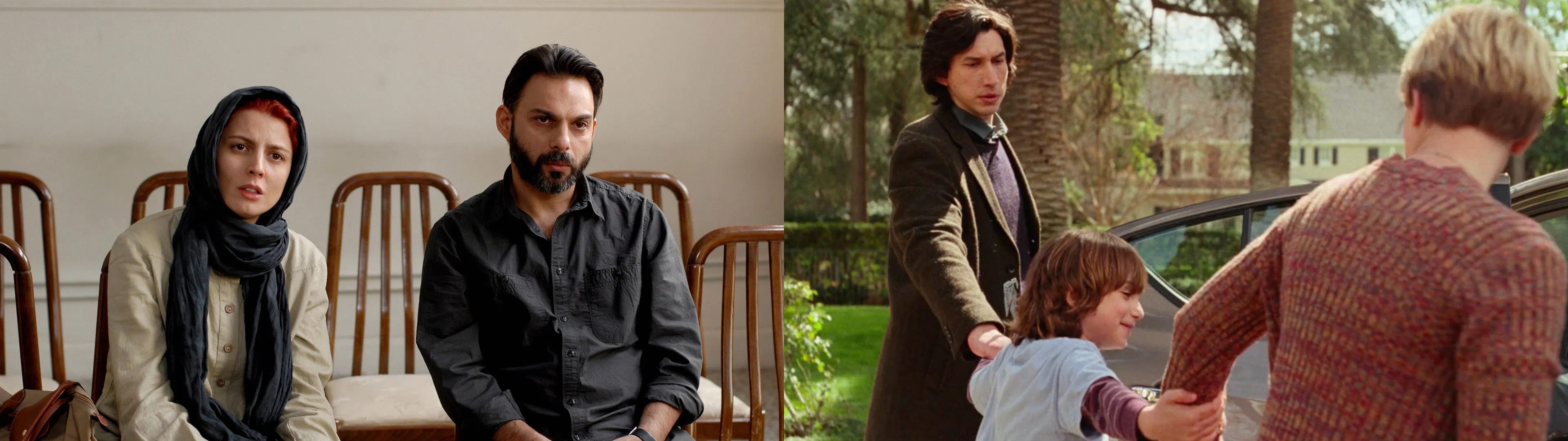
Marriage Story (2019, writeup by Christian Jessup)
Noah Baumbach has a way of making you hang onto every word of dialogue. From the showy monologues and dramatic argument scenes to casual conversations, his words in Marriage Story paint the picture of real people in a real relationship. There is love, anger, bitterness, care, resentment; you name it, it’s beautifully handled in this screenplay about the messy realities of divorce. And that’s to say nothing of the all star performances from Adam Driver and Scarlett Johansson, the tender musical score from Randy Newman, and Baumbach’s own steady directorial hand. It’s a film, as Driver’s character sings near the end, about “Being Alive.” Opening up to love means opening up to loss, irritation, and disappointment. “But alone is alone, barely alive.”
Dead Ringers (1988, writeup by Travis Kyker)
If Kristoffer Borgli just gave us his own grueling portrait of relational strain, it pales next to the dysfunction on display in David Cronenberg’s Dead Ringers. There are similar anxieties working through both films, such as the fundamental unknowability even of the people closest to us and the existential crises such a realization is bound to unleash; and where Borgli’s The Drama is really just as much a comedy, Dead Ringers too unfolds with a wickedly dry sense of humor. The most interesting difference between the pair is due to Cronenberg; his film doesn’t center a romantic relationship (though one plays a critical role in the story and theme), but rather a pair of identical twins (Jeremy Irons in one of cinema’s great double roles). This opens up ample material to interrogate the differences between appearance and inner nature, as well as the question of how two people so alike one another might be drawn together, and whether it is their unity or separation which is ultimately more terrifying. One gets the sense that, from the materialist perspective Cronenberg often inhabits as a kind of reductio ad absurdum, this is a lose-lose endeavor: one either remains trapped within themselves, genuine connection exposed as mere illusion, or gives himself up such that his own self is annihilated in the process.
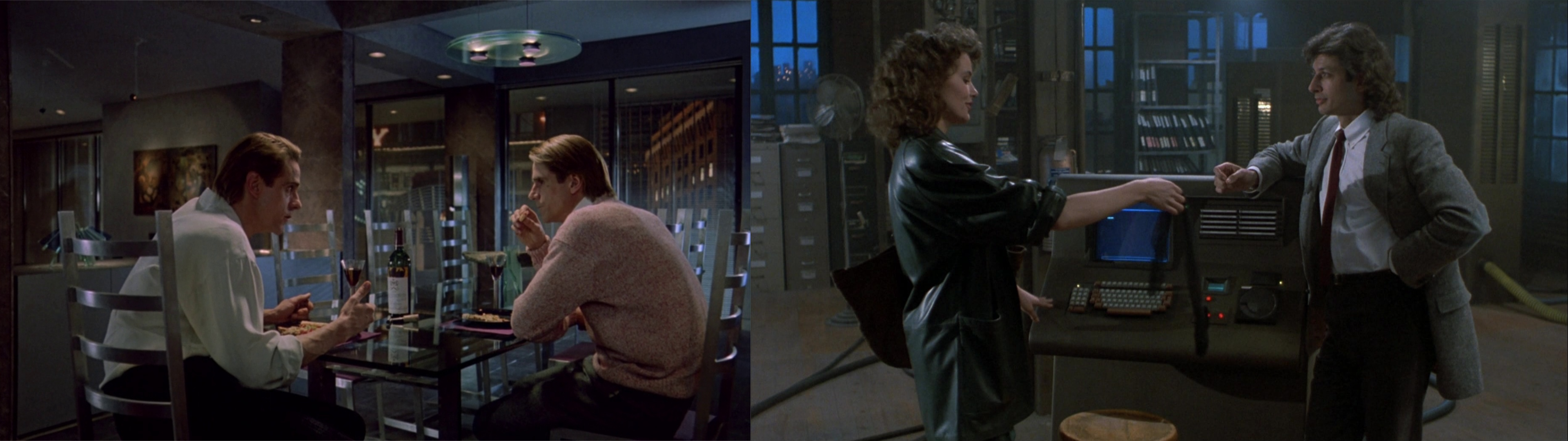
The Fly (1986, writeup by Timothy Lawrence)
David Cronenberg is renowned for his viscerally disturbing body horror and cerebral musings on the relationship between mind and body, but to my mind, the secret to his work's enduring power is that most of his movies are tragic love stories. Perhaps his best love story – and thus his most achingly tragic – is The Fly, about a scientist and a journalist who are brought together by the former's experimental teleporter and then torn apart when the device goes wrong and fuses the man's DNA with that of a fly. It is, unmistakably, a monster movie, but it carries a potent charge of pathos because it is also a genuine romance, centrally concerned with the paradoxical project of eros: the longing to become "one flesh" with the beloved, and yet retain one's own separate personhood. It is also a movie about the push and pull between love and vocation, in which the lines between a work partnership and a romance blur until the one literally absorbs the other – and when you know that Jeff Goldblum and Geena Davis were dating in real life while filming it, its picture of lovers brought together by their shared work becomes even more deliciously layered.
This Week at FilmFisher
New Piece

From the Archives


That’s all from us this week at FilmFisher. Keep a lookout for new pieces every week, and the Fresh Catch in your inbox every Thursday!